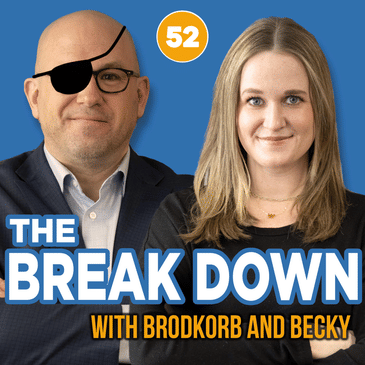
On this episode of The Break Down with Brodkorb and Becky, Michael Brodkorb and Becky Scherr are joined by former Rep. Kelly Fenton and John Rouleau for a break down of the election results from Super Tuesday.
- 00:01:30 - Michael explains why this week's episode was released late.
- 00:03:26 - A break down of election results from Super Tuesday.
- 00:23:40 - The "Uncommitted" vote campaign.
- 00:39:11 - Representative Dean Phillips and Ambassador Nikki Haley end their campaigns for president.
- 00:47:18 - Where do we go from here?
The Break Down with Brodkorb and Becky will return with a new episode next week.
Get full access to On The Record with Michael Brodkorb at michaelbrodkorb.substack.com/subscribe
[00:00:00] Welcome to The Break Down with Brodkorb and Becky, a weekly podcast that breaks down politics, policy and current affairs. I'm Becky Scherr. And I'm Michael Brodkorb. This episode is coming to you a little later in the week, but we are excited to bring you another
[00:00:24] panel conversation. We are joined by John Rulow and former state representative Kelly Fenton to recap the big holiday of the week, Super Tuesday. I'll start by reintroducing our guests. First up, John Rulow, who may be our most frequent guest to date. Sorry, Jeff Cole,
[00:00:39] be our guest host for most of your appearances. So we are giving this title to John. John is a longtime GOP strategist and operative here in Minnesota. He currently serves as the executive director of the Minnesota Jobs Coalition, also joining us for her third appearance,
[00:00:52] a former state representative Kelly Fenton. Representative Fenton served in the Minnesota House from 2015 to 2019 has served as deputy chair of the Republican Party of Minnesota and is a great messenger for Republicans in the state. Today, we are going to break down the recent
[00:01:07] presidential primary here in Minnesota. We will move into breaking down Super Tuesday results across the country and what they mean for the race. And of course, we will discuss the two candidates who dropped out this week, Ambassador Nikki Haley and Minnesota's own Congressman Dean
[00:01:20] Phillips. We will end with a conversation about where we go from here. Thank you for joining us today and enjoy the show. So Michael. Yes, Becky, we are recording this a bit late, which is unfortunate. We're recording this late because I turned 50 last year and have started
[00:01:38] to use reading glasses. I was in an event with my family on Tuesday night, attempted to put my reading glasses in and poke myself in the eye. I'm currently wearing an eyepatch because I scratched
[00:01:48] my cornea. I like to think like I look like one of my favorite movie characters, Snake Pliskin, from Escape from New York. I don't. I look like a complete and utter goofball.
[00:01:57] So we have to delay this episode one day as I recover from the scratch cornea that I have. I want to thank the course medical staff that helped me deal with the scratch cornea, but I'm currently recording this episode with an eyepatch, which is I've gotten no sympathy
[00:02:12] for my children about the fact that I'm wearing an eyepatch. I've heard so many pirate jokes, which I apparently didn't realize as a dad that I had shared so many pirate jokes with my kids,
[00:02:21] but they have been using the pirate jokes over the last day. And so I appreciate your patience and our guest patients as we needed an extra day for me to convalesce this ridiculous eyepatch.
[00:02:33] We are glad you are still here. While I appreciate obviously you sharing this with me ahead of time, I do wish I just logged on today and was greeted by this situation because maybe not. I don't know
[00:02:44] what my reaction would have been and I wouldn't want to laugh in your face. People are. Yes, I like to think that I look like Snake Pliskin, but I think I look like
[00:02:53] Madi Moody from Harry Potter. That's who I think really what I look like instead of Snake Pliskin, one of my favorite characters from the movies. But who I really look like is some goofball
[00:03:02] from Harry Potter. And so no, I appreciate your flexibility and patience. This is going to be a good episode. And thank you as always for your concern. It's always something. And now it's not
[00:03:10] just me getting hit by a car. We also need to worry about me putting my reading glasses on, because that's also a problem too. It is a dangerous activity. Is a dangerous activity. Thanks for doing this. You bet. Let's get to it.
[00:03:22] So we are excited to be joined today again by John Rulow and former Representative Kelly Fenton. And we are going to start all things a Super Tuesday by talking about the Minnesota primary, presidential primary results. Let's start with the Republican side. So we came in
[00:03:42] with President, former President Donald Trump got just under 70%. Nikki Haley got 28%. Santas and Vivek still got some. And let's I want to look at the numbers of the votes too, because I think that's also important. Donald Trump got 232,000 and Nikki Haley did not
[00:03:59] break 100,000. She did gain 12 of the 39 delegates here in Minnesota. And we will get into what happened after that. But I want to start out with John, are you surprised at all of these results? Did you think Haley would be higher? Did you expect Trump to hit that 70%?
[00:04:18] Yeah, I think looking at what's been going on across the country, this was where Nikki Haley needed to make a stand. But I am not particularly surprised that she ended up where she did. Throughout the campaign, we've talked about it after each of the debates,
[00:04:36] after each of these state selections. And she did pivot a little bit towards the end of her campaign. But there was for a long time, there was not an affirmative reason to vote for any of the other candidates who ran in this election. Everybody said I'm Trump-Lite,
[00:04:53] I am running against Trump. And there was no real from the outside looking in, there was no real strategy for how you go about winning these states. And I think anytime that you're running against what's essentially an incumbent president and you're
[00:05:09] garnering in that 20 to 30%, that's no small feat. But I don't think that it's surprising that she just wasn't able to find a way to win. And at the end of the day, you need to find ways
[00:05:20] to get over 50. Fenton, Representative Fenton, what are your thoughts on the results of Republican side? My thoughts are similar to what John said. I would have loved to have seen Haley at least break 40%. And I know that Nikki Haley and the team felt they came in
[00:05:40] below where they wanted to be. But you know what? No other female GOP candidate has walked away with delegates. And so I have to praise her. She took Vermont, she took Washington, D.C., and she garnered enough to walk away with 12 delegates from Minnesota. It wasn't enough.
[00:06:03] Trump performed pretty well. Let's be honest, in 2020, I think every political news outlet from whether in print or on TV basically claimed that Trump was dead. He was dead for good. And this is probably one of the biggest political comebacks I've ever seen in my political career.
[00:06:24] Would have loved Haley to do better and do more as a person who supported her. Absolutely. But she did break a few glass ceilings and that's always great to see. Now there was New York Times put together a breakdown of each state. We'll tweet out the link from
[00:06:41] this, but it breaks down into areas of how Trump and Haley performed. I don't think there's anything super shocking, but one thing I did want to point out is which I guess could be expected
[00:06:51] is how the margin shrinks demographically across the state. So when we're looking at urban areas, Trump only outperformed Haley by 18%. When we moved to suburban, he outperformed her by 32 points
[00:07:03] and when we get to the rural, it was by 57 points. So it is really, the rural Minnesota still is really Trump country. I don't think that's a huge shock to anybody. I don't think Haley's message, I think definitely resonates with us urban suburbanites here on this panel today.
[00:07:20] And I think that's what we probably expected if we were predicting this in the front end. Michael, do you have any takes on any surprises or thoughts of how Haley performed, how Trump performed here on Tuesday? I voted for Haley. Obviously, I would have liked to see her
[00:07:39] too stronger than she did. I'm not terribly surprised by the results, but as someone who voted for Haley, I obviously would have loved her margin to have been greater and I wish
[00:07:48] she would have stayed in the race, which we can talk about more. But the results are not incredibly surprising to me. And as I said, voted for her would have liked to have seen her a
[00:07:57] bit higher. But we'll get into more discussion I think about what this means for the election. But it's surprising where she's at and again, I wish she would have stayed in the race, but I would have liked to see the numbers higher. John?
[00:08:09] Yeah, looking at the race, I would say some of the things that did surprise me actually came on the Trump side of the equation rather on the Haley side. And what we had seen in 2016
[00:08:21] is that President Trump came in third place and we had what roughly 100,000 Republicans went to caucus that year. Everybody was talking about how it was the most excitement ever. Now we're talking about Donald Trump more than doubling the number of every vote that was cast at caucus in 2016.
[00:08:41] And so clearly the thing that you can take away is that the party has shifted and it is Donald Trump's party right now. And you can even see that down to looking at places
[00:08:53] like the third congressional district, which is one of those college educated. It's changed a bit since redistricting but used to be pretty reliably Republican back in 2008 2010 2000, at least at the congressional level. And we saw that Donald Trump was what in the mid 60s in
[00:09:12] that district Haley cracked 30. But those are the places that I think people were most concerned about slipping away from the Republican Party. But the fact that turnout was so high, and Donald Trump still did very well there. I think there's reasons for him to be optimistic about being
[00:09:29] able to potentially cobble together a coalition that he needs in November as he comes up with those strategies. John, I've asked before and this is a question I'll repeat from a previous discussion we had about election results. I had opined that I thought that Donald Trump being on
[00:09:47] the ticket made it harder for Republicans to win in 2024. You push back a bit on that. When you look at some of them and I thought your answer was like all of your answers,
[00:09:57] John, incredibly insightful and rich. But can you explain a bit a minute? Can you explain a bit after looking the results of Tuesday of Super Tuesday, particularly in Minnesota? Do you still subscribe to that school of thought that Trump is not necessarily as much of a negative
[00:10:11] that it has the potential for Republicans to still win in state, win statewide at least on the legislative races? I don't think anyone is articulating the possibility that Republicans are going to knock off Amy Klobuchar. But where do you think that is now based on what you
[00:10:25] saw in the election results on Tuesday? There's a few different things that are at play. And I think that I would differentiate between the top of the ticket being an asset and the top
[00:10:35] of the ticket being something that's going to drag everybody else around. And what I would push back on is the idea that Donald Trump is such a negative on the top of the ticket that down
[00:10:45] ballot races would just get totally swamped by him. There's been a lot that's been written and hypothesized about these so-called Trump voters who show up when he is on the ballot. And frankly, I think it's actually a little bit more simple than that. And we saw a realignment
[00:11:06] that happened in 2016 and beyond where Republicans certainly lost some of those college educated suburban voters, particularly suburban women voters. What we knew about those voters who used to be either a little bit of a swing voter or used to lean Republican is that they are very
[00:11:27] likely voters. They will show up for municipal elections, they will show up for off-year elections, they will show up for primaries, they will show up for presidential elections. And the new coalition that President Trump built, a lot of those there was talk about
[00:11:41] the Obama Trump voter think the high school educated, more working class, hardworking voter and there tends to be a less lower propensity to vote among that audience. So they tend to show up in presidential years in a midterm where Republicans used to outperform and exceed the expectations
[00:12:02] because they had those extremely likely voters. We've seen that flip a little bit on its head in kind of this realignment that we're seeing, but that means that those presidential year only voters, many of whom still like Donald Trump very much, many of whom dislike President Obama,
[00:12:19] those voters are back on the table when we're talking about turnout. The DFL has an absolute machine that turns their folks out whether it's a presidential year or not. And so I think in a presidential year with Donald Trump on the ballot there's reasons to be cautiously optimistic
[00:12:37] if Republicans can find a way to get their message out. Now the real kind of question mark heading into this year is that this election looks a lot more like 2016 than it looks like 2020. We have two, I think I would say historically unpopular nominees for each party. These
[00:12:55] candidates make Hillary Clinton look popular and we saw a very significant third party appeal in Minnesota in 2016 and Donald Trump really had hovered around that same number that most Republicans get statewide. It's in that 44 to 46 percent. He was right in there, but Hillary Clinton had a lot
[00:13:17] of those kind of third party split off voters. There were protest votes, the Libertarian Party did well, Evan McMullen if anyone remembers him did well, Jill Stein got a point. So across the board and what we're seeing is that there's likely to be third party candidates again. So
[00:13:33] there's a lot of question marks. There's a lot of time before election day, but I wouldn't write anything off right now because of Donald Trump being the party's nominee. I think that that was a great summation of the state of play here. This is something we've talked
[00:13:46] a lot in Representative Fenton. I know we've talked to you as being a former elected and candidate and being on that campaign trail and how the ticket does impact down ticket. I'm sorry, top
[00:13:57] of the ballot impacts down ticket. What's your take on that? And where do you think we do know that there are still these Haley voters? Do they still stay involved? They're still going to
[00:14:07] come out. I argue yes. And do you think this is going to be, we're going to see a case where Minnesotans love to jump back and forth right on their ballot. We do see, we've seen it before
[00:14:19] where we've gotten Republican majorities in the legislature and lost every constitutional office. So that's not uncommon. Do you think that might be something where we see if it's somebody that's just not a Trump vote or they either leave presidential blank across the aisle
[00:14:32] and still, we can still get those votes down ticket? Look, I'm on record for saying if Donald Trump is at the top of the ticket, we don't win the House back because you need the suburbs to
[00:14:43] win the House back. The suburban soccer mom just does not like Trump. But after diving through all of the numbers here, just here in Minnesota and then even across the
[00:14:55] country, I went back the ways to which we could talk about as we move on further on down the conversation. But I'm telling you, I think for the first time yesterday, I actually have hope
[00:15:07] that we can pick up, we can maybe we have there are pathways to victory in Minnesota. And I was saying that they weren't there before. But and I'll tell you what one of the reasons is like John said, as I've talked to people between from Tuesday to now,
[00:15:27] overhearing even conversations in the cafe at the grocery store and other places. What I'm seeing is Trump is 2016 presidential energy. I'm seeing 2016 energy. I was on the ticket in 2016. I was on the ticket in 2018 and 2022 2014 and 2016, even with Trump on the ballot.
[00:15:51] I won every single precinct in my own health district going to 2018. Then after Trump had been in office, you saw I went to maybe only winning two and narrowly losing almost other. And why
[00:16:07] is that? I think that was an anti Trump voters that came out. But the Democrats have a problem here in Minnesota, which I can see from their results. And there is very much a weakness in
[00:16:20] Biden. I would love for us to be able to win in Minnesota because of what the GOP stands for and who the GOP is. But I do see pathway to victory. And that's because it's going to
[00:16:31] be very much an anti Biden path to victory. His popularity, he's far less popular than Hillary Clinton is. If you want to go back and look at some numbers, I went all the way back to
[00:16:45] 04 and 2012. But for the first time in this election season for 2024, I actually have hope for here in Minnesota and pathways to victories here. Becky, that's it's pretty interesting the insight and the perspective that's evolved. This is one of the advantages, I think,
[00:17:02] to having John and Rep Fenton on the frequency that we have as we've seen their positions where they've gone. And that was a really interesting, I think, display of intelligence by both of them,
[00:17:12] but how their positions and where they come back to it's just nice to see that. And I think our listeners are going to appreciate both John's perspective and a little bit of how Representative Fenton's position has somewhat evolved based on new information. I really
[00:17:24] found that to be interesting. Rep Fenton, go ahead. I just want to add to that. There's one string that is hugely important that Trump carries and that is the loyalty of his voter. He has something like a 90 to 93% loyal voter retention rate, whereas Biden's is waning. He's
[00:17:46] actually bleeding voters. So that's our pathway to victory is the unpopularity and the unhappiness with Biden. And I do want to get into that too, because I think the Minnesota, the results on the Democrat side were interesting. As we Biden obviously won, he got as over 70% of
[00:18:07] the votes. They did have less turnout on the Democrat side than on the Republican side. The big story here though is that second place in Minnesota is uncommitted with just shy of 20%, 45,000 votes gaining 11 of the 75 Democrat delegates, which is, we'll come back to,
[00:18:24] Minnesota's own Congressman Dean Phillips got 7.8%, which is just shy of 19,000. And then Marianne Williamson who's back in the race, they got 1.5%. So I want to start by, we'll come back to the uncommitted side of things. I want to start by Phillips.
[00:18:38] We're going to chat more about the changing of the race and folks dropping out leader. But I think on a bed top is Congressman Phillips under 8% in his own state. I thought he would get more. I didn't think he was going to win Minnesota by any means.
[00:18:53] I thought more of like 12, 15% we could expect to see out of him. But what are your thoughts? We'll start with you, Representative Fenton. I was not surprised at all because the Democrat party as a whole across the country has done so
[00:19:06] much damage to the reputation of Phillips. And Dean Phillips and I are on the other side of the aisle, but I find it appalling what's been done to him. And if it could be done to him,
[00:19:17] it could be done to any one of us. And he also already disclosed that he was giving up his congressional seat. So he's not running again in the state. I wasn't, the biggest surprise
[00:19:30] to me is how far left have the Minnesota Democrats gone that such a large turnout for people who want to publicly be on the side of anti-Semitism and the killing of Jews and far
[00:19:45] out vote. One Jewish congressional sitting member of Congress right now, I think that is one of the biggest takeaways. But I'm not surprised given how Dean Phillips had been doing in the other matchups in other states and what the Democrats have done to his reputation.
[00:20:06] John, what are your thoughts on Phillips' performance? It's always difficult. We talked about it with President Trump who essentially is running as an incumbent within the Republican Party still. But running against an incumbent president is
[00:20:21] always a difficult thing to do. And I think the story is being undersold, right? And yesterday actually Tom Nichols tried to make a joke and say, imagine what the headlines would be like if Joe Biden was losing 10 to 50 points in every state. And he was trying to essentially
[00:20:39] say that the treating of Donald Trump as an inevitability and super popular was perhaps an overstatement. But we don't have to imagine Joe Biden lost between 10 and 50 percent in every state that he was, or 13 of 16 states that he was on the ballot in Super Tuesday.
[00:20:57] That is a terrible place to be as an actual incumbent president when you're losing what 15, 20 points to uncommitted when you're looking losing another 10 to Dean Phillips who I think Dean Phillips knew that this was always a long shot but it was about having a conversation.
[00:21:16] It was about opening a door and giving people a choice. That was what he had always said. But I was a little bit surprised that he didn't do better. He did come in second place in the
[00:21:26] third congressional district where he narrowly edged out uncommitted. But I've also got to hand it to him from a tactical standpoint. Uncommitted organized very quickly, spent very little money, the effort to get people to vote that way. I think what they pulled that together in two
[00:21:43] weeks and spent $20,000 or something on text messages and they were able to really put up some numbers. I think certainly like Representative Fenton said it points to where the DFL party and their base currently are. But also you've got to hand it to the people who
[00:22:01] ran that organizing effort because anytime that you can pull something like that together it's really impressive whether you agree with them or not. Absolutely. And to your point Congressman Phillips only got 14% of the votes in his own district which is shocking. Representative?
[00:22:19] I want to add just looking at the vote total that Biden got here in 2024, 171,277 votes. I did go back to other elections just to find something comparable. Income and see not a lot of reputable challengers if you will say. Obviously this is the first presidential race,
[00:22:45] primary race I think that we can now go back to for future primary races and whatnot. But I look at 2012 Klobuchar's primary total. She in 2012 and there's been first of all the Democrats have a great reputation of being pro primary voters
[00:23:08] right turning out to vote in these races. She got more votes and pretty much an almost uncontested race in 2012 and 133,000 plus. I'm sorry 183,000 plus votes that Biden got. Now there's been a huge population growth in Minnesota since 2012 as well.
[00:23:32] And I just find that really interesting. Biden and the Democrats in Minnesota are in huge trouble. So I want to go into that. We obviously have talked a little bit about this uncommitted. And so this was in Minnesota one in five Minnesota Democratic primary voters were
[00:23:50] a committed higher proportion than any other state. And so this was really, it was a push to show President Biden by folks that were supporting the unconfident vote. It was a push to show President
[00:24:02] Biden that they do not believe in his stance in the Israel war, that they want to stand with Gaza, free Gaza, eliminate Israel essentially right? That's some of the messaging that we saw coming
[00:24:12] out from that. I think what we've talked before on this podcast, I think we're all pretty appalled by this uprising and anti-Semitism. But Michael, I'm interested on your take of, you've been around a lot, seen a lot of kind of some of these flash polls,
[00:24:26] issue based or flash campaigns, issue based campaigns. This is like John said, done relatively last minute with relatively little time and money and resources. What are your thoughts on the 45,000 folks that voted this way, anti-Israel and the kind of horrific language and vitriol that we've seen behind this?
[00:24:52] I think it's concerning. I think it's first of all, the electoral success was strong. They certainly delivered a message here, particularly in Minnesota long term though. Where do these people go? I don't believe that the effect of this, that there's an outcome here that's going
[00:25:06] to make anyone that voted uncommitted happy. I have my doubts that the president is going to allow foreign policy to be dictated by how people vote in a primary election. Now, the Democrats historically at the national level and in Minnesota have a rich history of
[00:25:23] dividing themselves and creating some conflicts leading up to the elections on issues involving foreign policy in the war, particularly in Minnesota. We've had a number of former United States senators that ran for president in this state, particularly Eugene
[00:25:35] McCarthy who was focused and also member on issues related to the war and concerns with foreign policy. This can divide the Democratic Party. They're not united right now and one of the
[00:25:46] things, just keep it local here for just a second, I think one of the reasons that Trump did so well in Minnesota in 2016 was not because of the success of the Trump campaign, but because of disfaction and frustration that Democrats had post Bernie Sanders, Hillary Clinton
[00:26:02] that led to there being some Democrats that just stayed home. I think that if this uncommitted agenda isn't, if they don't resolve their conflicts potentially with the Democratic nominee, Biden, some of these folks could be staying home and it's a real concern.
[00:26:20] This effort is for Democratic strategists coming into the election. Also, let me just say for a minute that I think uncommitted is an absolutely poor message. I understand that people have concerns about what's going on between Hamas and Israel right now in the Middle East and
[00:26:34] particularly Israel and what's going on in that war. But I think I stand by my position that anyone who voted uncommitted is in a very complicated position. I think they need to justify and explain why they're not advancing, I think, a wave of anti-Semitism that's gone on
[00:26:52] since the attacks on October 7th and I think it may be end up being second only to defund the police as one of the worst messaging strategies that Democrats have done. I have a tremendous amount of concerns about where this message and where this belief system goes.
[00:27:09] It's just very problematic to me. I think that, and Becky, we've talked about this with a number of previous guests, how anti-Semitism has just become much more mainstream. I think that if anyone had voted uncommitted, I think that they are on a complicated ground. I think
[00:27:27] it's very reasonable for someone to call the uncommitted movement an anti-Semitic movement. It's a movement about pursuing an agenda that we've seen rise up very swiftly since in the aftermath of the October 7th terrorist attacks and I think it's problematic long term for Democrats.
[00:27:45] I think it's a real warning sign for Democrats coming into their national convention. I think it has the possibility of really bringing some volatility to that national convention and I think it's an issue that's going to have to be dealt with. I would not want to be
[00:28:01] a Democratic strategist today because I think the likelihood, and I say this as someone who didn't vote for Trump in 1620 or on Tuesday, I think that the more that this type of festers and
[00:28:12] continues there's a real possibility that this is going to be a pathway for Donald Trump to be elected president again. Representative, did you have something to add? Minnesota Democrats for the most part have always been to be known as centrist left, right?
[00:28:27] But what I see with the sun committed and what's going on is you've got the far left now coalescing their power and forcing some of the centrist left even more left. I think that leaves Tim
[00:28:41] Walls and Kim Martin in a real predicament because they need to decide are they going to embrace the far left activists or are they going to moderate their position? But unfortunately with
[00:28:54] Biden, his weak number and looking to right now be dragging down their ticket, well I think they should moderate their position. I think they're going to have to somewhat basically have to count out to the far left activists because they're going to need to keep every possible vote
[00:29:14] turnout, every possible voter. And I see them in a lose situation where many voters, you're in a situation where you can't win to lose and there's still a lot of many voters
[00:29:27] staying home. I think the only thing that I would push back on is looking ahead to the general election. And what we see is that elections in the United States are very often a binary
[00:29:41] choice. And in order for the Democrats, I think they can monitor this unsettling look of what's it like to lose 10, 15 points as an incumbent president with the idea that the people who are voting that way are the furthest left activists in their party. And those people have
[00:30:06] for them one of the best get out the vote strategies on the ballot in Donald Trump. And they will have to make a decision of whether or not they want to vote against Donald Trump.
[00:30:17] Yeah, this is going to be one of the first elections that I can remember where I would argue that a majority of the votes that are going to be cast on either side
[00:30:26] will be a vote against the opponent. This is not an election where people are voting for Joe Biden. This is an election where people are voting against Donald Trump. This is a vote.
[00:30:38] And the same thing goes, I think that Donald Trump likely has more of his voters. Representative Fenton talked about that loyalty factor. I think he has a majority of his voters that probably are still voting for Donald Trump, but absolutely on the left. And then I think
[00:30:55] a lot of those voters who are going to call them the mushy middle are going to make a decision on who they're going to vote against, not who they're going to vote for.
[00:31:03] So it really requires you to imagine a world in which these far left voters decide that Donald Trump would be better for the Palestinian people than Joe Biden, because we have binary choices
[00:31:16] in this country when it comes to the election. But the parallels to 1968 are absolutely getting a little bit eerie and we'll see how much longer those parallels last as the Democrats get ready
[00:31:28] to head to Chicago. So John, based on what you're saying in essence is that there may be this passionate desire to take this kind of principled stance right now and voting uncommitted. But when it comes down to the actual election ballot, it's your perspective right now that
[00:31:44] many of these folks will likely in the end of the day come home for the Democrats. Is that your take? When we're talking about the base, it's easy to take a very principled stand in
[00:31:56] a primary when there's very little at stake. But when the rubber hits the road and you're starting to make a decision, whether you're a Republican or a Democrat, if you're in a caucus, if you're in
[00:32:06] a primary, the risk to you is very low for standing up for what you believe in. But when you get to that general election ballot, when you walk into your polling place and there are
[00:32:19] for all practical purposes two names on that ballot and you have a choice to make, that becomes a real decision. It's less hypothetical, it's less. And I've always argued that primaries are good for our party, they're good for our country. The more people who are involved with
[00:32:35] that the better. But that's where we can have those conversations. Yep, parties disagree with each other all the time on what direction they should go. We're coming out of a primary season in the Republican Party where there was a conversation on what do the next four years
[00:32:51] for our party look like. And I think that certainly there's the people who still hold themselves out as the never Trumpers, most of them at this point are just Democrats. But
[00:33:04] we see that with a lot of the people who said that they were never Trump who stuck around as operatives. It doesn't matter if it's Donald Trump, they opposed people like Mitt Romney in
[00:33:14] his election and said that enabling a Republican is enabling Trump and going all out and spending for Democrats. I think at this point, most of those people are Democrats, but within the Republican Party, I expect that a lot of them will come home, especially those Haley voters
[00:33:33] will come home. The DeSantis voters will come home. But especially on the Democratic side, these uncommitted voters, I don't think that there's a way in that they sit down and say, I'm going to enable Donald Trump because they claim that he is an existential threat to the country.
[00:33:50] They would have to either acknowledge that they're being disingenuous when they say that or they would have to be okay with enabling him. So that's their choice. And it's easy to break off when the stakes are low. John, I think you have a very good high
[00:34:09] thought of our voters. That is very well articulated, very well thought out. I'd like to think that these 45,000 uncommitted voters are that thoughtful of the process. I'm not quite sure they are,
[00:34:22] but time will tell. Did you hear what he said about the never Trump? I'm right here for Pete Sakes. I'm sitting right here and he just said it. You'll have to share it with us once
[00:34:32] the general comes. What you plan to do. That's right. I will do that. Writing in is an option. You can still vote for the Republican ticket, but yeah. I do want to move on just to weigh a
[00:34:44] couple more topics to hit here in general. Super Tuesday, so Tuesday, March 5th, 15 states held their primaries, 854 delegates were up for grabs on the Republican side. Nikki Healy did win Vermont. So that was a win on that side, but Trump now does sit at 1,031 delegates of
[00:35:02] so just a little under 200 away from what he needs to clinch the nomination. Healy after Super Tuesday had under 100. So obviously we'll get into that topic of her dropping out here shortly.
[00:35:14] But I did want to also just share that Trump in 2016, it was close to Memorial Day before end of May before he got that 12, 15 or I don't know if the number has changed, but what he needed to clinch that nomination. In general across the country, Super Tuesday,
[00:35:30] any anything anyone wants to note? It was pretty predictable, right? Jason Palmer. Jason Palmer, yeah. Congratulations to Jason Palmer on running maybe one of the most brilliant ads that I've ever seen in American Samoa, where he ran an ad. I don't know if you guys
[00:35:52] saw this, but I'll send it to you. He ran an ad that was targeting the caucus there and that essentially said, you're probably wondering who I am, but I'm actually really well known on the mainland and I'm a real presidential candidate and essentially just convinced everybody that he
[00:36:09] was this really popular guy and was able to win a territory. So I did not have Jason Palmer winning a primary before Dean Phillips on my bingo card, but congratulations to him on his victory.
[00:36:26] What was the long play here? Is he trying to writing a book? Do we know anything about this guy of why this was the case? Why he spent money and time on this?
[00:36:37] Jason Palmer. I don't know. We see a lot of people run for office every year, right? It's relatively easy to get ballot access in certain states and certain territories and we've seen people run for president from prison. We saw Bob Garny is on the ticket again.
[00:36:54] I think we see a lot of these kind of races, but they usually don't end up beating a sitting president in a caucus. He's got a great story now to tell. I would have it on my
[00:37:04] resume. I want a primary in American small. That's a great little, he's going to be a trivia question, answer to a trivia question someday and it's a great talking point. It's a good icebreaker. Start rain. I'm not surprised at some of the turnout, but there were a few
[00:37:22] what I saw across the country I think too. I think there's an anti-incumbent sentiment going on right now and yeah they've been in there too long. I think it's time for them to
[00:37:34] go. In California, I was happy to see how well Steve Garvey performed in that race and so it's now going to be a Republican against a Democrat. I look at North Carolina, an interesting primary
[00:37:50] Super Tuesday was a young 21 year old running on the GOP ticket against a long time incumbent and the 21 year old won. One of the reasons he ran is he saw what happened between 2020 and 2021 now
[00:38:08] with his demographic, but he actually reached out to the sitting representative and never heard back from him. He's like you know what? Here he is now going to be running on the ticket for
[00:38:21] the North Carolina House because he beat a long time in competency. I have a good friend who always said the only thing that should last 18 years or more is a marriage and not the career
[00:38:33] of a politician. You look at how long Biden's been there. It doesn't matter side of the aisle, but I think we're going to even see that in Minnesota with Amy Klobuchar. She's been there actually almost 20 years. Everybody says she's the unbeatable incumbent, but I think this
[00:38:52] anti-encomment sentiment is going to that people have on Joe Biden and others as high. It's going to have some down ballad effect. Maybe she will win, but I think for the first time,
[00:39:06] maybe she'll have her on for her money too. We'll see. All right. I want to go into next topic for today for this week's podcast. Topic number three today is Haley and
[00:39:18] Phillips dropping out. I wanted to note that as I was working on the script last week's topic number three was Phillips floating a possible Phillips Haley unity ticket. Today, it's that they both dropped out. Phillips dropped out endorsing President Biden. Haley dropped out and did not
[00:39:38] endorse President Trump. She did so however leave the door open, I think in a good concession speech saying it is now up to Donald Trump to earn the votes of those in our party and
[00:39:47] beyond it did not support him. I hope he does that at its best politics is about bringing people into your cause, not turning them away and our conservative cause badly needs more people. I want to start with you representative Fenton. What is your take on Haley's statement here
[00:40:03] and her not endorsing President Trump? I personally did not think that she was going to immediately throw her way behind President Trump nor do I know that she will, but do
[00:40:12] you think that she will at some point? Do you think she is leaving the door open trying to push for unity but not fully getting in because she still does have that hesitancy? What are your thoughts?
[00:40:22] First of all, I wasn't surprised at the timing of her dropping out, but and not at all surprised nor did I think that she should have put her weight back behind Donald Trump. I agree with
[00:40:33] her he needs to earn the votes of her those who supported her. I think though at the end of the day they're all in it for the same reason. They are very unhappy with the policies of the
[00:40:49] Biden administration and I think both Trump and Haley can agree on that. I think she was very diplomatic and graceful in how she bowed out even though not getting behind Donald Trump.
[00:41:04] And I think she definitely left the door open, but I don't think she needed to throw her weight behind Donald Trump. I agree that Donald Trump needs to earn the support of those voters.
[00:41:17] I will note too on that though there was a recent NBC Morris poll that it's Maris poll that had said 80 or 82% of those polls said who voted for Nikki Haley said that they
[00:41:29] would support Donald Trump. But I think he has a lot of work to do because there's quite a few Nikki Haley supporters who also said they would never get behind Donald Trump. But at the end of
[00:41:43] the day, I'm a Nikki Haley supporter and as days as the day by day goes on and I learn more of what's happening within the Biden administration of what's been done now, I'm appalled and
[00:41:57] we'll see who's on the general ticket as we get closer to the election, whether there's third party or not. But there are days where I feel like a non vote for Biden, I'm sorry a non vote for Trump
[00:42:14] could be a vote for Biden and that the thought of four more years with Biden scares me a lot. A lot of people don't know that I grew up in Texas. I understand the border things down there
[00:42:26] that's been long term but my family also lived in China, in the United Arab Emirates, in India, in Vietnam. I've seen what it's like to be in communist countries, how the people feel being in those countries and it scares me when I see happening right here in America.
[00:42:48] I think certainly as we get towards the general representative and I think we'll want to have a further conversation with you about that because I think that is something that a lot of voters are going to have to weigh is if they don't think that they can
[00:43:00] vote for Trump or for Biden and don't vote or vote third party, we talked about this a little bit after the last election but I think a good conversation to have of different takes on that
[00:43:13] and what it truly means. John, what is your thought on Haley's concession speech not throwing behind Trump? Do you expect that maybe convention time will get a Haley endorsement? Yeah, I think strategically I hope that the Trump campaign takes the opportunity to welcome
[00:43:31] the Haley voters in and be the ones to extend that hand prior to her endorsement. Politics is an addition problem, right? It is how do we cobble together a coalition that gets to 50% plus one
[00:43:47] because if you don't get that, you can't win. Optimistic, President Trump sent out a truth yesterday that said that he welcomes Governor Haley's supporters to his team, which was a significant change from when he had been saying that any of her supporters and donors were going
[00:44:06] to be blacklisted from MAGA. So I think I'll be curious what the campaign does, what President Trump does, but also what his surrogates do, right? Kerry Lake who has been making outreach to just about every senator in Washington DC for her race decided to throw
[00:44:26] pretty petty jab at Governor Haley as she exited the race. And I think if anybody should understand that you need to bring everybody into your camp, you would hope that it would be
[00:44:40] you'd hope that it would be Kerry Lake who said that she didn't need or want the McCain supporters and then came up short. And you can pretty much draw a straight line from her saying,
[00:44:49] I don't want their votes to her not getting their votes. So there's got to be an ask, but I think as the campaign goes on, if President Trump courts those voters, I'd expect Governor Haley to follow her supporters and go along with it.
[00:45:04] That being said, you never know what Donald Trump is going to do, and we'll see what he says when he gets out there and has his first rally with her out. Michael, our gal Haley, Ambassador Haley is unfortunately out. What's your take?
[00:45:21] I'm disappointed again, as I said earlier in the show, I'm disappointed that she got out it. And I do hope one thing that the Trump campaign has never shown themselves to be as very magnanimous as John articulated successful politics is about addition and
[00:45:34] multiplication. And so I think it would be beneficial to the Trump campaign to reach out to Haley's supporter and to her directly. I think that they have a very long and well documented track record of poking success in the eye. So I hope that they don't do
[00:45:49] that. I do think that there's going to need to be a broad coalition for Republicans to win in November. I think they can win. I think in the aftermath of Super Tuesday, I think it would be better today to be a Republican strategist and a Democratic strategist
[00:46:05] looking at the upcoming election. I think that the opportunity for the Republicans to unite around Donald Trump is an easier fight right now than it is to get the Democrats to all coalesce right now where they're at. And hopefully, Republicans can get to that point where they
[00:46:22] can be that they can be united. But I think right now, the person who has to unite the Republicans, if he in reserve right now, he is the de facto head of the party. He is the
[00:46:33] math is clearly on his side. He's just a couple hundred votes away from officially becoming the nominee with the right number of votes. And so in that kind of driver's seat where he's at, that campaign and the leadership of the Trump campaign needs to have some outreach
[00:46:49] and needs to be magnanimous. But they have a tendency to not do that sometimes. I think they should. I think that Governor Hayley, Ambassador Hayley ran principled, positioned, thoughtful campaign. I think there were a number of voters in the party who
[00:47:04] consider themselves to be Republicans who wanted to vote for her, who wanted her to see the nominee. And I do hope that the Trump campaign, just speaking from a partisan perspective, it would be good if they were able to do that type of outreach. That is not something
[00:47:19] that they have been successful with in the past. Hopefully, though, they understand the position that they're in and where they're at and how having united Republican front will help the ticket up and down. But we'll see. I think John articulated well, and I agree also with some statements
[00:47:35] that Repfenton made too. So this is perfect segue into the last segment here of where do we go from here? Michael, quick follow up on that. What do you attribute that to the Republican side being in a better position than Democrat? Is it because
[00:47:52] the division on the left largely stems around this Palestine, Israel war and tragedy and every awful word that we can throw at it. And it's so divisive that it's hard for a Biden or
[00:48:07] others to come back from. Or what do you think? What would you look at? Is it Biden's mental capacity? What do you point at as showing Republicans? Because I agree. I do certainly agree and Repfenton alluded to that earlier too, but curious of what your take is
[00:48:23] the catalyst. We've discussed this in the past, Becky. We specifically had a discussion about where President Biden is at and where former President Trump is at from an age perspective. I generally believe, based on just both of their presentation styles, that Donald Trump shows more
[00:48:42] vigor, passion, and if there is a discussion about the age of the candidate, I think Donald Trump is doing a better job of showing passion, showing vitality than Joe Biden is right now. I also will say that I agree directly with what John has said, which is that
[00:49:01] Donald Trump is a tremendous get out the vote force for the Democrat. But I think that with, I think there is a confidence issue that a number of Democrats are having right now
[00:49:12] with is Joe Biden. And I think Americans are too, is to the competency and Joe Biden's ability to govern and lead as president. I believed, didn't touch on it in my last question, but I'll use it as an opportunity here to say, I think Dean Phillips was
[00:49:26] incredibly poorly mistreated by the Democratic base. I think that he took a very brave, substantive position. And as I've articulated many times on the show, the big fan of Congressman Phillips and his message in what he's saying, I'd say I don't
[00:49:39] agree with him, contrary to John's statements about him on a number of issues. I think he was right. I think at the end of the day, where his position was based on the polls, based on where Americans are. And if Joe Biden does not win on election day,
[00:49:55] there are a lot of Dean Phillips supporters and Dean Phillips people who could go back and say, told you so. I told you. And so what I think the problem right now with Joe Biden is that
[00:50:05] there is a lot of apathy towards kind of his leadership. I think that there's the economy where we're at. We're in a position right now where the economy we're shaping up. Joe Biden
[00:50:17] is not getting much, is not getting much reward for the successes that are happening. And they're seeing, I think a lot of Americans are seeing president who they have concerns about whether
[00:50:29] he can lead. And I think you add in this foreign policy dynamic of what's going on between Israel and Amos and this strong faction of voters inside the Democratic Party who want to vote
[00:50:42] uncommitted. I think that Joe Biden has a number of hurdles that he has to overcome to unite the base. But to John's point and to what others have said on this show is that I think what Joe Biden and
[00:50:54] the Democrats have going in their favor right now is Donald Trump being the nominee. And so the question is, can they get their act together in time to be a voting block against
[00:51:04] Donald Trump? Because as John said also, it is a binary choice. I do think that people people a lot of times I think fear is a tremendous motivating factor that gets people to the polls. And the fear potentially of Donald Trump becoming president may outweigh some of their
[00:51:21] other issues that they're having with their incumbent president. The only thing that I would add is that the issue that Joe Biden and the Democrats are facing is that he is bleeding support from both sides of the spectrum within their party. Yeah,
[00:51:39] I think we talked a little bit about that uncommitted voter in the primary and I think I'd stand by what I said. I think those voters come home that is the furthest left portion of
[00:51:49] their base, that is the group of people who probably changed their Twitter handle to something with resist in it. And those people will absolutely be motivated by Donald Trump and the opportunity to vote against him. The bigger flashing warning sign if I am Joe Biden
[00:52:06] and the Democrats is that kind of Trump slash Biden voter. It is the Obama Trump voter. It is the suburban Romney than Clinton voter. And you've got those swingier mushy middle voters who are not
[00:52:25] enthusiastic about Joe Biden. They are not confident in his cognitive abilities. They are not confident that he is up to the job. And even if you set that aside, they do not like his policies.
[00:52:37] They do not like by dynamics and the inflation that is crushing their families still. And those people you have a real problem with because Donald Trump probably isn't going to be the
[00:52:47] motivator that he is to those voters that he is to the furthest left portion of the Democrat base. So if you start to see apathy there, if you start to see those voters deciding that they are
[00:53:00] going to support Donald Trump, if you start to see those voters deciding that they are not going to vote or if you see those voters saying that they will vote third party in some sort of a protest,
[00:53:10] there is a not insignificant percentage of voters who throw up their hands and say really, these guys are our choices again. And those are the voters who I think Joe Biden has to
[00:53:22] be concerned about losing. We'll see what happens tonight when he gives his State of the Union speech. It's an opportunity to get out in front of voters since he had passed on kind of the
[00:53:33] traditional Super Bowl address. And you know, his team made the determination that he wasn't up for that challenge. So tonight will be the first test so to speak of this campaign where we'll see candidates going head to head and giving dueling speeches, giving dueling
[00:53:50] rallies, hopefully debating one another. And so this will be a very interesting preview of how Joe Biden is able to do in that setting. But I think that's the real risk for the Democrats is
[00:54:01] that Joe Biden's losing it on both sides. I don't think anybody would argue that when it comes to Donald Trump that his base is not 100% locked in and with him. So while they still
[00:54:12] you know have that mushy middle that they need to go and figure out how to shore up, they're at least not losing their base. Representative anything to add there? I absolutely agree with John as I mentioned earlier, Donald Trump has a very loyal base and
[00:54:28] he's absolutely solidified it. And then when you look at where Joe Biden is bleeding voters, he's bleeding them the black voters, he's bleeding the Latino voters, he's bleeding the Asian voters as well. Then you have the whole Hamas Gaza issue going on policies.
[00:54:48] He's telling people, Biden is telling people that the economy is good, people are doing well. Yet me personally and other moms I talked to when I go to the grocery store, I'm paying maybe the same amount of money and bringing home half of what I used to bring
[00:55:07] home for that same amount of money. So people know they understand they're living a completely different situation than Biden is telling them that they're living. Then we go to the issue of immigration, public opinion of most everybody on both sides of the aisle is
[00:55:26] something needs to be done about immigration and things that are happening right now. Then you have in the larger cities, you have what's happening with the crime. So Biden is not doing well on any of the issues that matter to the average American voter right now.
[00:55:45] Let's take a look now at right here in our own state. Minneapolis public schools is going to have to make significant cuts because they are not going to have enough money. They're going to be bankrupt if they don't. But yet how can the Democrats spend that?
[00:56:03] It's been completely run, that city, that school district is completely run by Democrats. No Republican vote in the legislature could have helped them pass anything right? You can't spend that and say it's the Republicans fault like they've tried to do
[00:56:20] with other things. So I think on all of the issues that matter to the American voter, economy, immigration, public safety, education, Biden is failing. He's bleeding voters. Donald Trump has solidified and has a very loyal base and voter base.
[00:56:43] Thank you for that. It looks like we are coming up against the clock right under an hour again. Booyah, I want to thank you guys for being with us. Representative, can you share
[00:56:53] where people can find you on social media? Thanks. I'm on X at Kelly Fenton MN as well as Instagram at Kelly Fenton MN. Fantastic, John. People can follow along at John underscore Rulo on the bird app.
[00:57:16] Thank you guys so much for being here. As Michael said, it's really been great to see Chad through this evolution of where we started six, eight months ago and where we are. So we'll certainly have you back. We're grateful for your time, for your insight,
[00:57:33] and thank you for being with us. Thank you. Thank you. Thank you guys again. Thanks. We want to thank you for listening to the breakdown with Broadcore Rebekah. Before we go show some love for your favorite podcast by leaving us a real and Apple podcast,
[00:57:48] Spotify or on the platform where you listen. You can leave a review or give us a shout out on our website or across all social media platforms at BB Breakpod. The breakdown with Broadcore Rebekah will return next week. Thank you again for listening.