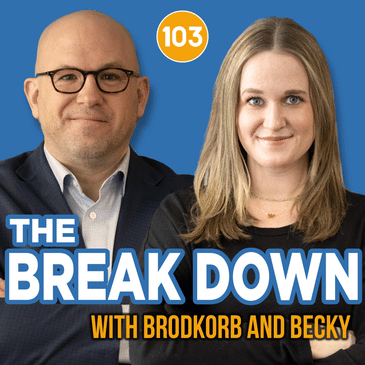
On this new episode of The Break Down with Brodkorb and Becky, Michael Brodkorb and Becky Scherr interview former Republican Party of Minnesota Chairman and State Senator David Hann.
Hann, who is considering a run for governor in 2026, shares his perspective on the importance of focusing on the gubernatorial race amid the buzz surrounding the U.S. Senate race.
Hann discusses his political career, the current political climate challenges, the need for Republican unity, and practical solutions for Minnesota's key issues, such as education, public safety, and economic growth.
Join the conversation as Hann outlines the path forward for Republicans and the need for strong candidates in the upcoming election.
- 00:00 Introduction to the Podcast
- 01:24 Interview with former Republican Party of Minnesota Chairman David Hann
- 08:32 Discussion on Republican Strategy and Challenges
- 12:27 Reflections on the Endorsement Process
- 27:11 Closing Remarks and Personal Updates
- 35:58 Final Thoughts and Farewell
The Break Down with Brodkorb and Becky will return with a new episode soon!
Get full access to On The Record with Michael Brodkorb at michaelbrodkorb.substack.com/subscribe
[00:00:12] Welcome to The Break Down with Brodkorb and Becky, a weekly podcast that breaks down politics, policy, and current affairs. I'm Becky Scherr. And I'm Michael Brodkorb. We are kicking off this week by looking forward to 2026. Today we are jumping into the candidate arena by interviewing Chairman David Hann, who is exploring and considering a run for governor. When we last spoke to Hann, he was serving as chairman of the Republican Party of Minnesota, where he served from 2021 to 2024.
[00:00:37] Prior to his work leading the state party, Hann was a state senator representing District 48, which represents Edina and Minnetonka, from 2017. Throughout his tenure at the Minnesota House, he held a variety of leadership positions, including assistant minority leader, chair of the Health and Human Services Committee, as well as chair of the Education and Finance Committees. Hann has a long history of public service, including being a member of the Edina's Eden Prairie School Board, a member of the board of directors of the Hiawatha Leadership Academy, and president of the Parents for Accountable Schools.
[00:01:06] As we move closer to the election and more candidates announce they are running or seriously considering throwing in their hat into the statewide office ring, we will be reaching out and hopefully having as many conversations with statewide players as we can. We look forward to substantive interviews with candidates on both sides of the aisle seeking to serve Minnesota voters in the U.S. Senate or as governor. Thanks for joining us and enjoy the show. We are excited to welcome Chairman Hann back to the show. We are in the depths already.
[00:01:33] It is only March here, but it is 2026 season. And so we've had a lot of attention recently about the U.S. Senate race. But we know that one race that is also statewide coming up on the ballot is the governor's race. This is something that you are considering. Talk to us a little bit about the decision and why you are toying with that, considering exploring that, taking on the governor's race. Thanks for having me. It's good to be with you.
[00:01:59] As you may know, but when I got elected in 2021 to be the chair, I thought that within five years, by the 2026 cycle, we could elect a Republican governor and have a majority in the Minnesota House and Minnesota Senate. That was the goal. I still think that's feasible. It's been a long time since Minnesota Republicans have had that so-called trifecta. And I think you have to go back to Harold Lavander in the 70s, the last time anything like that happens. Because it's something that we have to do as Republicans. I think it's possible to do it.
[00:02:28] And even though I'm not the chairman any longer, I still think that there are things that can be done. And I've been talking to people and trying to find out who candidates might be, what they're... And frankly, as you said, there has not been a lot of talk about the governor's race. There's been some speculation about Tim Walz, whether he's going to run for its third term. I personally think he will. But there's been a lot of talk, a lot more talk about the Senate race. Recently, Melissa Franzen, former senator, has announced that she's going to be a candidate. We've got Peggy Flanagan. So there seems to be a lot more buzz about that.
[00:02:58] But as far as Minnesota is concerned and the people of Minnesota, we need to have better governance than what we've gotten from Democrats, frankly. And the time is ripe, I think, for that to occur. I've been speaking to leaders in the House and the Senate. There's a high degree of confidence, and I think it's well-founded that the Minnesota Senate will come back as a Republican majority after the 26th election. And I think the Minnesota House will be a majority for Republicans as well.
[00:03:23] And the Democrats, of course, are doing everything they can to prove to the people that they are not fit to continue governing. And frankly, Governor Walz is doing the same thing. So there's an opportunity there, and I think it's in the interests of the state and the interests of Republicans to make sure that we have as strong a candidate as we can find. Someone who can reach the voters that need to be persuaded to put Republicans in a position to govern the state. That is really the goal. I've been asked to consider it. Frankly, I have not made any decisions.
[00:03:52] I guess there's only one person that I've heard that's officially announced, a party activist. And there's been some other people that I've heard are maybe thinking about it. I guess part of what I'm hoping is to encourage people who are serious about doing this to get involved and get into it so that we can have a fair opportunity to make sure we have the strongest candidate possible. Mr. Chairman, I'm trying to think of this in the right context. And I think that when we've discussed this, I think you're just planting the flag because there's a lot of tension right now in the Senate race.
[00:04:20] Because obviously, Senator Smith has announced that she's not seeking reelection and open seat is a great opportunity because open seats don't come along very often. But I think if I understand, you're just planting the flag and saying Republicans, centrist, like-minded Democrats, let's not lose focus on the fact that there's a governor's race. And we need to be making sure that Republicans have a good candidate running. Am I understanding it right? Yeah, I think that is correct. I've talked to a lot of people.
[00:04:45] There are some, frankly, who are a little discouraged by the opportunity that we have as Republicans to elect somebody this year. They point to typically in the midterms of a presidential cycle, the out party, quote unquote, tends to do better. That's historically been, I think, more often than not the case. And so you'd think the Democrats are going to have a leg up because Trump is in office in Washington. But I do think that there are some dynamics going on that Trump has certainly played into.
[00:05:13] And part of it is exposing the Democrats for the kind of mess that they're in. They have been captured by a very left-wing element of their party, the so-called progressives or the socialist democratic element, whatever it is. Certainly, they're in the majority of Minneapolis on the city council. There is concern on the part of a lot of Democrats that this is not good for them as a party, not good for the state, not good for the country. And there's a lot of hand-wringing going on nationally with the Democratic Party. How do they fix this?
[00:05:39] They've gotten so obsessed with Trump and they've gone so far down this path of whatever you want to call it, progressive philosophy, wokeness, whatever it is. They're not connecting with people on the issues that are important to people, such as, in Minnesota, a great example, education. We've got now less than 50 percent of grade school kids that are able to read and do math at a grade level.
[00:06:00] It's just unbelievable. That has deteriorated remarkably since Tim Wallace has been in office and Democrats have had the controlling power in state government going back to Dayton and even before that. But that's something that affects everybody. And people expect that to be fixed. And it's not. It's just spending more and more money on a higher degree of failure.
[00:06:17] Things like public safety and the continuing effort to discredit effective policing or to discredit the idea that maybe we shouldn't have criminals and people who are here in the country illegally running around and doing whatever they do. And we should try to find a way to resolve that. And the Democrats are saying, no, we love immigrants. Everybody loves immigrants, but we want them to be here officially. The economic picture has deteriorated. We've got strong evidence of the fact that Democrats and Tim Wallace have done things to chase businesses away.
[00:06:46] I've been reading a lot about this Family Leave Act that is coming into effect here pretty soon. And I think the legislature is trying to come to terms with that. But businesses are leaving the state and certainly leaving the city of Minneapolis. All these things are issues that are important to a vast majority of the people in Minnesota. And the Democrats are not effectively addressing those things. And so it's a great opportunity for Republicans to do that.
[00:07:12] And you need a candidate who's willing to do that and willing to go into Hennepin and Ramsey County to make that case. That really is the key. We have seen this going on for years. We have a strong presence out state, which is great. But every year, whether it's a presidential or a gubernatorial cycle, Democrats win in the metro area 70% to 30%. Doesn't matter who the candidates are, Republican, Democrat, doesn't matter what the cycle is. 70-30, 70-30, 70-30, 70-30.
[00:07:37] We don't need as Republicans to win a majority in the metro area, but we need to lose by less. 60-40 would put us in a position to be effectively to win. So the question really is, can we find a candidate that is willing to do that, willing to spend 60-70% of their time in a campaign talking to those centrist voters,
[00:07:58] soft Republicans, those independents, maybe even Democrats who are disgruntled, and find where we can agree, not 100%, but maybe 80%, 70%, that they are willing to say, we need to change. That the kind of government we're seeing from Democrats is just not working and we need to try and do something better. And you need a candidate on our side who's willing to do that. And I think it's possible.
[00:08:20] So I'm hoping that there will be more focus to this so that we can get campaigns working here by early summer, certainly before the fall. So because the election starts soon, it doesn't start next May. It starts soon. And we have to get going. I do want to come back and chat a little bit more about kind of the candidate selection process and how that all goes. But I want to keep on this path because I think you hit on a couple of really important things. Namely, obviously, like you said, historical context of midterm elections are not always great for the party in power.
[00:08:50] However, we've seen a lot of great things from Trump on the messaging side and in different factions of voters in Minnesota and elsewhere that he's been able to pull over the finish line. And then you hit on paid family leave. And I think that this is something that here in Minnesota, Republicans have a really big, important thing to do this election cycle is reminding voters what Democrats have done over the last two, four or six years. And a lot of that is spending down that $18 billion surplus, adding a $2 billion of taxes.
[00:09:19] We just had the February forecast coming out looking even more bleak than November. And then we have some of these laws like paid family leave that they punted, right? They punted until after the 2024 election to take effect. Some may say it's because they want to give businesses and stuff enough time to do it. I look at it more as they were punting until after the election because they didn't want people to see the money coming out of their paycheck layoffs happening and the real effects that these are going to have on small and midsize businesses across the state.
[00:09:46] But talk to us about the role that Republicans have both at the legislature, at the state party and candidates at all levels to remind voters of that and how crucial that is going to be to our success in 2026. You're exactly right. I think those are all, in addition to the other things we talked about, public safety and education. But certainly, just as an aside, the complete lack of attention to the wastefulness in spending that has gone on under the Walts administration. $250 million, at least. I've heard speculation that it's more than that.
[00:10:15] Feeding our future and the other programs that are being administered by the Walts administration. And the money just going out the door, not for the purpose for which it was intended, even if that intent was good, but completely being captured by criminals. And there's nobody in the Walts administration who's taken any responsibility for any of that. The governor hasn't. He's blamed the criminals, and certainly the criminals are at fault. But what about his administration?
[00:10:39] What about his commissioners who have overseen this flood of money leaving the public coffers, if you will, to go into the hands of the scammers? And where's the accountability for this? But you're right. Republicans at all levels in the legislature, and I'm sure they will, they need to make the point that this is completely unbelievable that has happened. And we need to start spending some time looking at not just good intentions. There was a book written years ago, more money and good intentions are not enough, and it isn't enough.
[00:11:07] You can't just say, oh, we're going to feed kids and then spend a bunch of money and have it go out the door. And it doesn't go to kids at all. That doesn't accomplish anything. And we have lost sight of making sure that what we're doing is being effective, spending a bunch of money on education. It sounds great. We're funding education. But when you look at the results and you don't see the performance improve, what are we doing? Now, we're seeing the Trump administration, of course, focusing on this through Doge. And maybe we need a Minnesota Doge, something that would focus on where is the money going and how is it being used?
[00:11:36] And is it being used effectively? Are the problems actually getting solved? Are we doing things to try to attract businesses to Minnesota? Or are we doing things to drive them away? But those are all questions that I have great confidence that Lisa Damath and Mark Johnson, the House and the Senate, that's going to be the focus of their campaign is to say, look, we've done the best we can with a very thin margin in the House and the Senate. And we need a few more votes. We need a few more members on our side. And we can start to correct some of these things. But these are things that are affecting people in Minnesota every day.
[00:12:05] And Democrats have not shown any seriousness about trying to make those things better. That's the opportunity. And that's the challenge, I think, for our candidates is to make that case to the people who can provide the votes to put us in a majority. I don't want to steal your own noise, but I know you're not announcing anything today and you're still considering it, but it sure sounds like you're running. And so there's a lot of messaging points in there. You've obviously put a lot of thought in it.
[00:12:30] You have a really unique perspective with your history up at the state legislature, working really with how laws are made, how we get things passed, the legislative process, which is obviously important to somebody sitting in the governor's office. And also at the state party, because I think that's something that a lot of times there's great intentions. We have great candidates who are poor legislators or elected officials, and we have great elected officials who are poor candidates.
[00:12:55] And I think that having those two things is something that you bring to the table that a lot of other candidates don't. We also know I spent a couple of years over at the state party myself and the infighting that there is within the Republican Party is certainly ongoing. We've talked a lot on this podcast about the endorsement process, and I know there's a lot of differing of opinions when it comes to the endorsement process.
[00:13:20] It has been very successful of the endorsed candidates being successful at the primary and coming out and being our general election candidate. However, we've also had some really flawed candidates that have made it through that system. I like to sit on the fence there because I think it's like a chess game that if you prepare well enough, you can win. And I like the strategy of that. But talk to us about that when it comes to some of these statewide races. Does it need to be reformed?
[00:13:45] Is there a path forward for sensible, steady-handed, good messenger candidates that are not bombastic and just going up there and pitching some of that red meat? What's the path forward for that as you see it formally being right in the nitty-gritty of it? Yes, and certainly there is a need for reform. I've been an active member of the Republican Party for a long time. I've been to many conventions. I've been endorsed by conventions as I was also the chairman of the Republican Party. So I certainly have an interest in making sure that the party is successful.
[00:14:15] But the process that we are using just has not been effective. There are too many people in the party, frankly, who look at endorsement as the most important thing to accomplish when it is just a step in the process to a bigger goal. The goal is to win a general election. The endorsement is a way to get on the ballot, but that's not the end of the game. And if you have candidates that are so focused on that, and when you have a group of delegates that represents a fairly narrow segment of the Republican voting base,
[00:14:44] we have, what, two and a half, three million voters. And this last cycle, we had 13,000 people show up at precinct caucuses. And so you've got a very small pool of people. Does it represent all the voters in Minnesota? And it clearly doesn't. And so we get people going through a process to get endorsed, which is not unimportant. I certainly wouldn't say we shouldn't do that. But they've lost the focus on the goal is to win an election.
[00:15:07] And I think in the party, there has to be a reform to recognize that and do some things to make that process more effective. We had a plan to, this year, actually put a great deal of effort into going out and making sure we had an effort that would go out through the rest of this year to encourage people. Go to the Rotary Clubs. Go to the Lions Clubs. Go to whatever. Talk to people. Here's what the precinct caucus process is. Here's why we need to do it. Here's how it works in the political process.
[00:15:35] Why is it important for you, average Republican, conservative, not engaged particularly except by voting? Why it's important for you to participate in that. We need to have a perspective in the endorsing process that represents the state more completely. Now, a lot of people have gotten very frustrated with this. And there's been calls for let's get rid of it altogether. Go to a state primary. Many states, most states probably have that. That's been out there as an idea for quite some time. I'm neutral on this. It's up to the legislature. They're the ones that have to change the law to do it.
[00:16:03] I just think that it's probably not going to happen in time for the 2026 election. So I don't want to get too invested in advocating for a let's change and become a primary state in a period of time when there may not be any hope that could get done and recognize that what we have is what we have. Let's try to make it better. I'm not sure what can be done at this point, but there should be efforts to try to make it better.
[00:16:26] And in any case, candidates need to, I think, start out with the view of the goal is to win a general election and endorsement is a step on the way. Like to have that endorsement, but that's not the end of the story. And you've got to start campaigning right away about what are you going to do? Who are you running against? You're not running against other Republicans. You're running against Tim Walz. You're running against a Democrat.
[00:16:47] We have, as a party, spent far too much time fighting among ourselves, trying to make sure that we drive away the Republicans that aren't as good as me, for example, and not enough time thinking about let's find ways we can work together, even if we have differences, and focus our energy on trying to fix the state, which is clearly in bad shape under this Democrat progressive governance that we've seen in the last few years. So that, to me, is the challenge. There is a way to get better at this, but there has to be a commitment on the part of the organization to do that.
[00:17:16] And we tried a few things when the last state convention didn't go so well, but we still need to keep working at that if the party is going to actually be effective in helping people get elected. Each of us on this call, Becky was the former executive director. I was the deputy chair under a previous chairman. Mr. Chairman, you served as chairman for a number of terms. Why is this a puzzle piece that all of us at our times in our careers, why is this a puzzle piece that Republicans haven't been able to fix?
[00:17:43] Because I think that you've laid out very succinctly why there needs to be a focus from the Republican perspective on the governor's race, what would be the issues. But you've really narrowed in, I think, on an operational problem that Republicans have in this state. And I guess my question to you, Mr. Chairman, and also to Becky is, how is this? We all, I think, agree that it needs to be solved. But why is it, why has it been so far out of reach for Republicans to resolve this? Because my first convention was in 1994.
[00:18:11] And I remember that in the 94 convention, there being discussions about we have a sitting governor and we're not going to endorse him. The party process needs to change. And here we are now over 30 years later and we're having the same conversation. Why is this so far out of reach for Republicans? I think it's a, maybe it's a cultural thing, if you will. I've talked to a lot of people, of course, in the party over the last few years in particular. But there's a sort of almost a perverse pride that we take in being so dysfunctional. Think of it as dysfunction.
[00:18:41] People say we're grassroots or we're independent or we're so independent, et cetera. And that's all fine. But people have lost sight of the fact that political parties exist for one reason, to win elections. And if you can't win elections, it doesn't matter anything else. You can talk about policies. You could talk about platforms. You can do all these things. But if you can't turn that into victories, you can't create majorities that can govern, then it doesn't matter. Now, 20 years ago, 25 years ago, the Democrats were like we are now.
[00:19:10] And they realized that they had to change, certainly during the Pondi era. And so they did things inside their party. They created, they reformed themselves, if you will. And they become, and as much as I disagree with the Democrats, I have to give them credit. Their organization has been in Minnesota very effective. And now the former chair of the Democratic Party has been made the chairman of the National Party. And I think partly because he pointed to the things that they were able to do in Minnesota. Our party needs to recognize that it doesn't matter what enterprise you're in,
[00:19:39] you can't accomplish your goals if you don't have the organizational capacity to do those things. And we shouldn't take pride in our sort of dysfunction. We ought to be thinking about how do we get to be effective. And I think that is the problem. We just have not spent enough time recognizing there is, I come to believe in my term as the chairman, that was the single biggest problem as a party that we faced is that we have just not gotten serious about what the mission of the party is, which is to win elections.
[00:20:08] And what do we have to do then? How do we have to, what do we have to do to be effective? We have to raise money. We have to get better organized. We have to focus on not picking fights among ourselves, but looking at how do we defeat Democrats. All those things have to happen. And I hope that we can continue to work on that. But in the short term, if the party is not able to do all those things, I think Republicans have to find a way to get to the ballot and to make the case to the public at large. That is the thing that I hope that we can get some candidates for governor to get out there,
[00:20:36] start working on this and focus on winning a general election. This is an opportunity time for us. And I completely agree. I think one of the main issues is that for it to really be changed without legislative action, it needs to be changed from within. And the delegates aren't going to take the power away from themselves at this point. And I, again, I came up, I was BPOU chair. I came up, I went to all of the state conventions.
[00:20:59] I was on endorsement committees for Tom Emmer and Mike McFadden and really love that process and what it can represent. But I also see a number of different flaws in it. As a single mom, or as a single mom, as a young mom, still married. I'm about to have my second child. It's a lot of commitment, right? You're asking these folks to go out on a snowy February and then go to their BPOU or CD convention to get elected to the state,
[00:21:25] which they often have to travel, pay hundreds of dollars overnight to participate for a full weekend. That is in May where a lot of kids have sports or there's confirmations or graduations. It is a lot to ask of folks. And as a party that's supposed to be the party of the grassroots, it does inherently push folks out of that process. Additionally, I think one of the things that I get so frustrated that we see with this is the amount of time that has to be dedicated, right? This is you mentioned hoping some folks get in this summer.
[00:21:53] Basically, it's fall until May that we're focused on 2,500 delegates and alternates focused on them spending all of our time, resources. I think even in the case of some recent statewide candidates, million of their dollars on this. That's a lot of money. That's weeks of TV time. And that is a substantial effort in the actual campaigning that needs to go towards the primary and to the general.
[00:22:18] And when we need to bring more voters, like you talked about, from different areas in, rather than spending five days a week talking to a room of 20, 30 delegates, alternates, activists, which who are very important to our successes as Republicans. I am not trying to diminish the role of the activists or our BPOU system and the small party units we have around the state. But there's just so much that's troublesome with that.
[00:22:43] And unfortunately, right now, the way the Constitution and bylaws are written within the state party, that is just how the case goes. The Democrats have been able to go. We saw Walls and Dayton not get the endorsement and still come out successful. I think that there is a path forward for Republicans to take a similar stance. We have also seen Democrats been really successful at keeping a lot of their dirty laundry behind closed doors. And Republicans, like you said, we in this state really like to air that out fully, much to the detriment.
[00:23:09] It's almost if you're not 99 percent with me, you I'd rather vote for the Democrat or not vote at all, which is just a mindset that I don't get from some of these different factions of our party. And this is something Michael and I have talked a lot about because we both, like you said, that we're really in deep with Republican partisan Republican politics and just don't really feel like that's the place for us right now. And so I think that's what we need to do.
[00:23:35] That's what we need our statewide candidates in 2026 to do is to coalesce around all of these like minded voters, bring us back in. And I'm really hopeful that we can do that. I know we're coming up on time here. One last question I have for you is with your time again at the legislature and at the state party, you were privy to a lot of information of feedback from Minnesota voters, both from strictly Republican voters and activists with your time at the party and your constituents when you were served at the Senate.
[00:24:03] Talk to us about what you believe Minnesota voters are looking for and what it's going to take to get Republican candidate over that finish line in 2026. I think the short answer would be they want common sense. They everybody is an expert in politics. There's no entry level test required to be interested in politics. But I think that most voters are looking for things that are going to be able to be accomplished. Number one, that are going to make their lives better.
[00:24:29] Politics is not and it shouldn't be a winner take all kind of proposition where you get everything you want and the other side gets nothing of what they want. We've seen that unfortunately happen in the last two years as the Democrats have ruled. That has not worked out, I don't think, very well for them for a lot of reasons. But as a political movement, if you will, the goal is always to try to build broad coalitions of interest where there's more that we agree on than what we disagree on. That to me is really what people are hoping for.
[00:24:57] To most voters, compromise is not a bad word. They recognize that half a loaf is better than none or a quarter loaf is better than a half. And so it's not I have to win everything or I'm going home. They want to see progress. They want to see movement toward something better. They want to see some of the problems that we know are out there. They want to see those things get it. I think that's frankly one of the reasons why the Trump administration, even at this point, is still polling very favorably.
[00:25:22] People are supportive of the fact that they're looking at where the money is going and the waste. People have been talking about this for years. The incredible amount of money that the federal government spends and where is it going? And we've just got piling up this debt. It's been going on for a long time. And it's just been talking. Nobody has done anything about it. And now you've got a president who campaigned on doing that, is doing that. I think he's going to have some success with that. And people look at that and they say, that's a practical thing that is going to be helpful to my life, my kids' lives.
[00:25:51] Most people realize you're not going to solve every problem with government. We shouldn't expect it to. But we can do things that are important and frankly are the role of government. Things like education, things like public safety, things like building an economic environment where people can thrive and grow businesses and protect their financial interests as a family. Those are the things that voters are looking for. They're not looking for some kind of absolutist vision of the future. I think that's part of the problem the Democrats have.
[00:26:18] They've got this sort of absolutist woke vision of what we all should be like if we can only be compelled to be that way. And I think, unfortunately, on our side, we've got some factions of our party that look at that in a very narrow way as well. But the general voters, I think, are looking for more practical solutions to problems. And Republicans have always, going back to the very beginning, been focused on getting those practical things done. And we need to find a return to those roots. Mr. Chairman, it's been a pleasure to speak with you today. And I hope you know that you're welcome back any point. And we look further as we go down this road.
[00:26:48] We talk more about the 2026 election pertaining to the governor's race. We would love to have you on at any point. As a candidate, analyst, whatever path you decide to choose. But it's been an absolute pleasure and joy to speak with you today. And I really appreciate you taking time out of your schedule to talk to us. Glad to do it. Thanks for having me. It's always fun to talk to you guys. And we'll see what happens down the road. But I think we're in for a good cycle if we can just take a couple of steps in the right direction. Thank you. Absolutely.
[00:27:15] Becky, you just interviewed former Republican Party Minnesota Chairman and State Senator David Hand, who is considering a run for governor, but is also just wanting to get people to focus on that. Normally, I would ask you for your immediate reaction. But I think we need to discuss just to maybe discuss some potential breaking news. I always assumed that you were married with a child, kid on the way. And there is a little news that I just want to make sure we unwind for our listeners. Are you currently a single mom? No, I am not.
[00:27:44] I'm very happily married. I'm a couple of weeks away from my third anniversary. I found a second child with my husband. I think my mind was working through how to articulate what the delegates and alternates and how difficult it is to go through that process. And so I was debating whether I was going to talk about the working parent, the single parent, the farmers and all of that. And I crossed two of my lines of thought. No, I am very happily married here. No change of status there. Good to know.
[00:28:14] He's a Packers fan. My wife is a Packers fan. We got a football season coming up. Vikings have made a lot of trades. I hope he's not going anywhere. So let's just make sure. That's good to know. Back to the interview. Yes. I thought it was a fantastic interview with Chairman Han. Give me your perspective on it. Yeah, I really did, too. I've had the pleasure of spending some time with Chairman Han when he was up at the Senate and I was working there. And just over the years through his involvement in the Republican politics, the Republican Party and the like, and we've had him on the podcast before.
[00:30:38] And I think that's what I'm getting from Han. And it's something you also have to applaud. We also look at a lot of candidates, especially statewide, as people that are egocentric and have the big egos. To see someone like, obviously. To see someone like Han willing to also say, I am going to take the time to consider, but also please others consider. It's really important. Yes, I would agree.
[00:30:59] And so I saw the news that had been published that he was considering this and I reached out to him and I was really impressed by his perspective, which was, look, he acknowledges he's won some elections, lost some elections. But I thought he staked out a very thoughtful claim, which is, look, I'm going to just say that I hope it's he wants there to be a focus. And the flag that he staked out is I think that Republicans have an opportunity in the governor's race.
[00:31:24] Let's not lose sight of that with the Senate race, with all the attention and interest of disclosure. Right. Everyone, I was a Republican for Harris. I endorsed Walls in 2022. We always want to do a fair job of having people on the podcast independent of personal views on stuff. And I thought I was really impressed. First of all, your line of questioning was just spot on. And I was really impressed by his answers.
[00:31:48] And I was it came to myself, it came to the clues like, yeah, there's a real path here for someone to market themselves in that type of way. This is not a situation where I think it's someone who is clinging to the last opportunity they have. This is someone who I think is very articulately and very thoughtfully staked out a position as to why they he believes that a Republican candidate can succeed on issues that I think you and I would both agree would resonate with a lot of people.
[00:32:15] The only challenge we have is I think that kind of nugget is on the endorsement process. And what I worry about is candidates that are thoughtful, that have an operational understanding of what it takes to win, like Chairman Hand, who has an understanding of the process, like former state senator Chairman Hand, former state senator David Hand, and who has all that knowledge. Is that the type of thing that gets rewarded?
[00:32:39] Because I got to tell you something, your questions and his answers, I could make the case that there's a and I do. I will make the case. I'm making the case that there could be a real market inside the Republican Party slash kind of centrist movement for a candidate right through that lane. Because it's tough for me to look at it and say, if I was that type of voter, which in some ways I am, but obviously elections a long ways away.
[00:33:04] There's a lot of good messaging that he just offered as to why a Republican, what a Republican could message on and accomplish two things, win the election and build the party. Completely agree. And that's also we have before the 2026 election, we have to finish out this session. We have to get through the next session. There is going to be a lot of fresh perspectives of what Governor Walz and the Democrats are doing.
[00:33:26] And we can remind Democrats or voters of what the Democrats, their shenanigans at the beginning of this session, not voting for any of the fraud or oversight and accountability issues. There is going to be a lot of different things that we can message on in addition to the education and the public safety and the economy and the different messaging and issue points that that Chairman Hand focused on. We need somebody who can message, who can do it all. And it's exciting to have these conversations a little step outside of the Senate race.
[00:33:54] We'll make sure to keep dueling conversations because it's certainly two different, two statewide races, but two very different positions that we're looking at here. And it's going to get busy and fun and I can't wait. One last question for you. I think, and please push back, but I think I just would like to know your answer on this. You hear a lot of times of candidates, you hear a lot of times about candidates flirting with running and they want some type of groundswell. I legitimately think that the flag that he's taking is what he truly believes.
[00:34:23] This isn't some coy attempt. I think he, from speaking with him and particularly even more after this podcast interview, I legitimately believe that he is just saying, come on in, let's get a whole bunch of us running and let's revisit and let's talk about the governor's race. That's legitimately my perspective. I think that you see candidates as you described, egos and they always want it to be about them.
[00:34:45] But I sincerely get the sense that Chairman Han would be happy if by issuing this clarion call and raising the alarm on this, he would love there to be a whole host of candidates of his caliber in and let the primary and the delegates decide to the degree which the delegates are going to decide. But let's let the system play out and may the best person win. Do you get that? Because I got that perspective from him. Absolutely. Because I also think there's something to be said about the first candidate in the race and announcing early.
[00:35:14] And if he thought that it was the most important thing at this point, he certainly could have done that today, tomorrow, yesterday. And I really do think that he... There is one candidate that has announced. Well, sir. Philip Parrish has announced that he's running this. But I do think that he has a long history of public service. I'm trying. I'm not trying to fact check it. I just want to... We are an informed podcast. We are. I appreciate you keeping me on it. Like we needed to issue the clarification that you are still married. Yes. Happily. Happily.
[00:35:43] There is one candidate. Correct. It's good to know. But yes, he has a long history of public service. He knows what it takes to be a candidate, to be an elected official. And I truly do believe that if it's not him, he will stand firmly behind another strong candidate throughout the process. And we look forward to that. Absolutely. Becky, I want to thank you for doing this today. I'm glad to know you're still happily married. I'm sure your husband will be happy to come home from work and know that you're still there. That's great.
[00:36:12] And I want to thank all of our listeners for joining us for this episode of The Breakdown with Brock Corbett. Before we go, show us some of your favorite podcasts by leaving us on Apple Podcasts or the platform where you listen. You can also follow us on our website and across all social media platforms at BB BreakPod. The Breakdown with Brock Corbett will return soon. Thank you so much for joining us today. Bye. Bye.